To prevent abuse of free credits, we use a hashed device signal (browser identifier, basic device characteristics and network). We don't store the raw values.
Markers and whiteboard
Line art
Colour illustration
Business and diagrams
Dark boards
The older name for a hand drawn explainer, and the reason it used to cost a fortune.
Updated: 2026-10-26
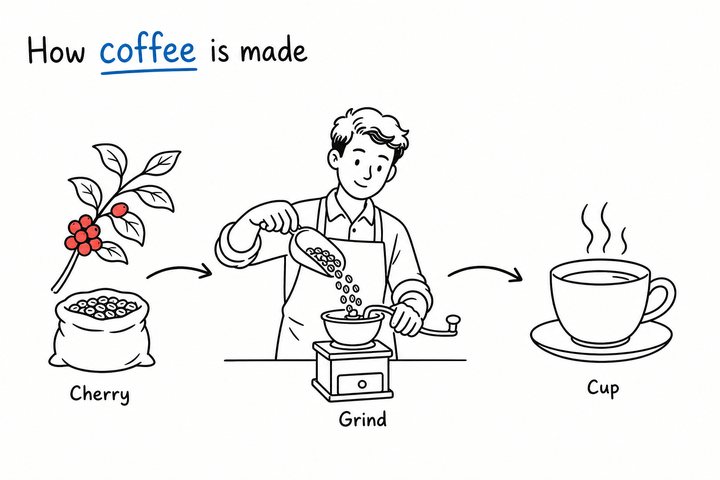
Video scribing is the British and agency-era name for what most people now call whiteboard animation: a hand drawing an illustration on a plain surface while a voice explains something over it. The word 'scribe' came from the live practice of graphic recording, where an illustrator stood at a wall and drew a conference talk as it happened. When studios moved that to camera and added a voiceover, the format kept the name. Video scribing, scribe videos, sketch videos and whiteboard animation all describe the same thing.
A scribed video was three separate crafts. Someone wrote a script that could be drawn. An illustrator drew every frame or every asset by hand. Then an editor timed the drawing to the narration on a timeline, frame by frame. A two-minute scribe took a studio one to three weeks and was routinely quoted at two to five thousand dollars a minute. The cost was never the drawing; it was the timing, because the hand has to reach each element exactly as the voice names it.
Reveal. In a scribed video the picture is incomplete while you are talking, so the viewer stays to see what the line becomes. A finished slide gives everything away in the first second and the eye leaves. That is the entire mechanism, and it is why scribing outlived the trend that made it popular around 2012.
The three crafts collapse into one pass. The script is written or pasted. Each section gets a whole illustration generated for it rather than assembled from a shared clip-art library. The narration is synthesised with a timestamp on every word, and the drawing is revealed against those timestamps, so the hand reaches each object as the voice names it. The step that used to take an editor a day is the step that is now automatic.
It suits anything with a sequence or a structure: a process, a mechanism, a comparison, a history. It is wrong for anything that depends on a real face, a real place or a real product surface. If the honest answer to 'what would the drawing show' is 'a photo of the thing', use a photo.
Write the narration first, one idea per sentence, and check that every sentence names something drawable. Pick a length and write to it. Choose a style and keep it across the series. Then render, and check the opening line and the board splits before you publish. The full sequence is in the step-by-step guide.
Yes. Video scribing is the older name, more common in the UK and in agency proposals; whiteboard animation is the more common search term now.
Agency quotes still commonly run from about a thousand to five thousand dollars per finished minute, with one to three weeks of turnaround.
No. The board, the ink and the hand are all rendered. Nothing is filmed.
Yes. The drawing still appears stroke by stroke; the hand is optional and is a style choice rather than a requirement of the format.
Sixty to ninety seconds for social and product pages, two to four minutes for teaching a mechanism. Past about five minutes the reveal stops being novel and structure has to carry it.


